
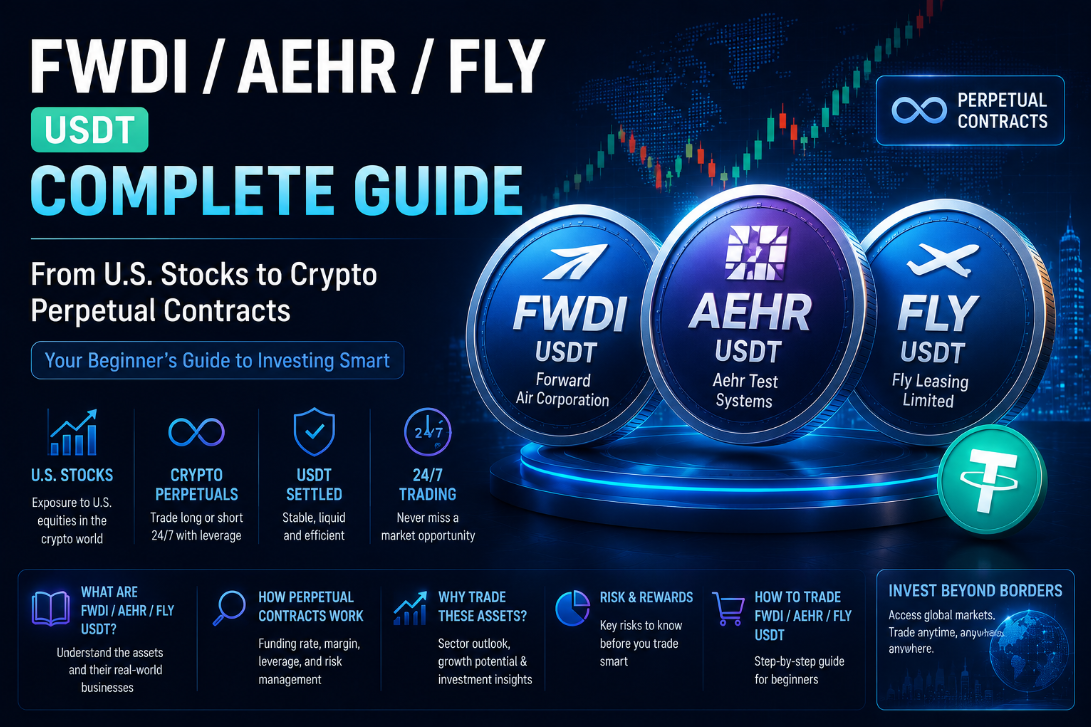
If you’ve recently spotted FWDIUSDT, AEHRUSDT, or FLYUSDT on OKX or another crypto trading platform, your first reaction might be: What coin is this? Why are stock tickers showing up on a crypto exchange? Am I buying shares or a contract?
That’s exactly where most newcomers get tripped up when they first encounter “stock perpetuals.” FWDI, AEHR, and FLY are not cryptocurrencies in the traditional sense – they are underlying references for stock-based perpetual contracts. Users are not trading the actual company shares, but rather derivatives that track the price direction of the corresponding stocks.
According to OKX’s announcement, the exchange launched FWDI/USDT, AEHR/USDT, and FLY/USDT stock perpetuals on July 27, 2026. All three are USDT-margined perpetual contracts with 24/7 trading. FWDI/USDT opened at 09:00 UTC, AEHR/USDT at 09:15 UTC, and FLY/USDT at 09:30 UTC.
The core value proposition: crypto users can use USDT as margin to trade exposure to US stock price movements without going through a traditional brokerage account. But that also means this is not a stock – you get no shareholder rights and typically no dividend entitlements.
In simple terms:
FWDIUSDT, AEHRUSDT, and FLYUSDT are essentially a hybrid of “US stock price action” and “crypto perpetual contract mechanics.”
They are not altcoins, nor direct share ownership – they are stock-price derivatives.
1. What Are FWDI, AEHR, and FLY? Why Are Stock Tickers on OKX?
When crypto newcomers see FWDI, AEHR, and FLY, the biggest question is usually: “Is this a new token?”
The answer is no.
These tickers originate from the stock market. OKX has structured them as USDT-margined stock perpetuals, allowing users to trade price movements of US stock-related underlyings just like they would trade BTCUSDT or ETHUSDT perpetuals.
But the underlying logic is completely different. BTCUSDT references the price of bitcoin, ETHUSDT references ether, while FWDIUSDT, AEHRUSDT, and FLYUSDT reference the publicly traded stock prices of listed companies.
1.1 What Is FWDI?
FWDI corresponds to the stock-price performance of Forward Industries.
According to Forward Industries’ official website, the company currently positions itself as a Solana-focused digital asset treasury firm, with a strategy that includes buying, holding, staking, trading, investing in, and developing SOL and SOL-related digital assets, protocols, and businesses. Public filings also show that Forward Industries’ common stock trades on the Nasdaq Capital Market under the ticker FWDI.
However, trading FWDI/USDT on OKX’s stock perpetual is not the same as buying Forward Industries shares.
You are not becoming a shareholder, you have no voting rights, and you do not directly receive company dividends. You are trading a perpetual contract tied to the price movement of FWDI stock. Your P&L comes primarily from contract price changes, leverage, funding rates, and your position direction.
If you believe FWDI-related stock prices will rise, you can go long. If you expect them to fall, you can go short.
The key distinction from traditional stock investing: buying stocks means acquiring the asset itself, while stock perpetuals are about trading price direction.
1.2 What Is AEHR?
AEHR corresponds to the stock-price performance of Aehr Test Systems.
Aehr Test Systems is a semiconductor test equipment company headquartered in Fremont, California. According to the company’s website, Aehr provides test, burn-in, and reliability verification solutions for semiconductor devices across wafer-level, singulated die, and packaged device formats. The company also notes that its high-power packaged device reliability and burn-in test solutions for AI accelerators, GPUs, and high-performance computing processors have placed it in the fast-growing AI semiconductor market.
That’s a key reason AEHR has drawn attention from crypto users.
The AI boom has driven chip demand, which in turn lifts semiconductor manufacturing, packaging, testing, equipment, and supply-chain players. Aehr Test Systems is not an AI chip designer like Nvidia, but it sits in the semiconductor test-equipment chain – a downstream support segment of the AI chip ecosystem.
Therefore, AEHR/USDT stock perpetuals may be influenced by semiconductor cycles, AI chip demand, company orders, earnings results, customer concentration, industry competition, and broader tech-sector sentiment.
But again: trading AEHR/USDT is not buying AEHR stock – it’s trading a perpetual contract on AEHR stock price exposure within the crypto derivatives market.
1.3 What Is FLY?
FLY corresponds to the stock-price performance of Firefly Aerospace.
According to Firefly Aerospace’s investor relations FAQ, the company completed its IPO on August 8, 2025, and trades on Nasdaq under the ticker FLY. Firefly Aerospace is an aerospace and defense technology company, described in public materials as a market-leading space and defense technology firm.
Thus, FLY/USDT stock perpetuals reference not a crypto asset but aerospace, defense, commercial launch, space services, and related stock-market sentiment.
For crypto users, FLY/USDT offers a way to gain exposure to aerospace-tech stock price swings using USDT. But this remains a contract trade – not a direct purchase of Firefly Aerospace shares.
1.4 Why Is OKX Offering Stock Perpetuals?
The emergence of OKX stock perpetuals reflects a broader trend: crypto trading infrastructure expanding into traditional financial assets.
Traditional stock markets have several limitations.
First, trading hours are restricted. Even with pre-market, regular, after-hours, and overnight sessions, US markets close on weekends and holidays. OKX’s documentation also notes that US stock markets are closed on weekends and US public holidays.
Second, cross-border investment has high barriers – users typically need a brokerage account, USD funding, compliance checks, and regional availability.
Third, traditional stock investing is mostly buy-and-hold; shorting or using leverage is less accessible for average investors.
Crypto markets, by contrast, offer 24/7 trading, USDT margin, perpetual contracts, two-way positioning, algorithmic execution, and a global user base. OKX’s official definition of Stock Perpetuals: they are perpetual swap contracts that track the price of publicly listed stocks, allowing users to trade stock-price movements 24/7 using USDT as collateral, without holding actual shares or using a traditional broker.
That’s the core reason stock tickers appear on crypto platforms: exchanges are packaging traditional financial asset price exposure into contract formats familiar to crypto traders.
2. What Is an OKX Stock Perpetual? How Is It Different from Buying US Stocks?
The key to understanding FWDIUSDT, AEHRUSDT, and FLYUSDT is not to start by researching the companies – it’s to first understand “stock perpetuals.”
Because you are trading a contract, not a stock.
2.1 What Is a Stock Perpetual?
A stock perpetual can be thought of as “stock price action + perpetual contract mechanics.”
Traditional stock investing means buying shares and owning a piece of a company. A stock perpetual, however, is a derivative that lets you trade price changes – you can go long or short, your position is supported by margin, and the contract has no fixed expiry.
OKX’s documentation states that stock perpetuals have no expiration date; users can hold positions continuously as long as margin requirements are met and funding fees are paid.
Example:
If you are bullish on AEHR’s stock price, you can open a long AEHR/USDT position.
If the AEHR-related contract price rises, you may profit; if it falls, you may incur losses.
If you are bearish on FLY, you can open a short FLY/USDT position.
If the FLY-related contract price declines, you may profit; if it rises, you may lose.
That’s the core logic: you are not buying the company – you are trading price direction.
2.2 Stock Perpetuals vs. Real Stocks – What’s the Difference?
They are fundamentally different.
Buying real stock typically means you hold company shares through a brokerage account. You may have voting rights, may receive dividends, and can hold indefinitely without worrying about perpetual funding rates.
Trading stock perpetuals is entirely different: you have no share ownership, you are not a shareholder, and you have no voting or dividend rights. You use USDT as margin, trade price volatility, and can employ leverage and go both long and short.
OKX’s official FAQ clearly states that Stock Perpetuals are derivative contracts – users trade price changes, not underlying shares; they can be traded with leverage on either side, 24/7, using USDT as collateral, and do not confer dividends or voting rights.
So newcomers must avoid a common pitfall: seeing AEHR/USDT does not mean you own AEHR stock; seeing FLY/USDT does not make you a Firefly Aerospace shareholder.
You are participating in high-risk derivatives trading.
2.3 Why Do Crypto Users Like Stock Perpetuals?
There are three main reasons.
First, unified capital.
Crypto users typically hold USDT, BTC, ETH, and other assets. To gain US stock exposure traditionally, they’d need a brokerage account and USD funding. Stock perpetuals let them trade directly with USDT margin, reducing account switching and conversion costs. OKX’s docs note that stock perpetuals use USDT as margin and settlement currency, automatically converting USD-denominated external stock prices into USDT pricing.
Second, two-way trading.
Traditional stock investors are more accustomed to buying and waiting for upside. Stock perpetuals allow both long and short positions. If you think the AI chip chain is rising, you can look at long opportunities in AEHR; if you believe aerospace stocks are overvalued, you can express a bearish view via FLY/USDT shorts.
Third, nearly 24/7 position management.
Crypto users are used to trading at any hour. OKX stock perpetuals support 24/7 trading, allowing global users to adjust positions even when traditional stock markets are closed.
But this also brings new risks: during market closures, contract liquidity may drop, spreads may widen, and prices may deviate from the actual stock market.
3. OKX Stock Perpetual Trading Mechanics – A Detailed Look
Stock perpetuals look similar to BTCUSDT or ETHUSDT perpetuals, but their price reference is more complex because they bridge traditional stock markets and crypto derivatives.
3.1 How Is the Stock Perpetual Price Formed?
OKX stock perpetuals do not simply copy a single stock exchange price.
According to OKX’s documentation, the stock perpetual index uses the standard OKX index calculation methodology and incorporates multiple price sources in real time as index constituents. These sources include real-time stock prices from data providers, stock perpetual prices from other crypto exchanges, OKX’s own contract prices, and index prices from other venues. Constituent weights are determined by market share, trading volume, and data quality.
This means FWDIUSDT, AEHRUSDT, and FLYUSDT contract prices are not from a single source – they result from a composite index and collective market action.
During regular US trading hours, real stock price data carries higher weight.
During after-hours, weekends, or holidays – when traditional markets are closed – the index relies more on OKX’s own contract prices and other exchanges’ stock perpetual index prices.
That’s why stock perpetual prices may differ slightly from what you see in your stock-tracking app.
3.2 Why Can You Trade When Stock Markets Are Closed?
Traditional US stock markets are closed on weekends and holidays, but OKX stock perpetuals support 24/7 trading. That’s because the contract market itself can operate continuously.
However, when stock markets are closed, underlying stock prices no longer update in real time. To maintain orderly trading, OKX uses index price and mark price mechanisms, applying appropriate pricing measures during closed periods. OKX’s docs also caution that during closures, weekends, and holidays, liquidity may be lower, spreads wider, but index price protection helps maintain pricing order.
This is critical for traders.
Don’t assume that “24-hour trading” means “24-hour depth and equally reliable price discovery.”
Stock perpetuals can still trade when US markets are shut – but risks may be higher during those times.
3.3 What Are Index Price and Mark Price?
Anyone trading contracts must understand two prices: index price and mark price.
Index price can be thought of as the contract’s reference composite market price. It comes from multiple data sources, not a single exchange’s quote.
Mark price is used for risk control, unrealized P&L calculation, and liquidation triggers. OKX’s docs state that stock perpetual mark prices follow the standard formula: mark price = index price + moving average of basis.
Why have a mark price?
Because contract markets can see temporary anomalies. If liquidations were based solely on the last traded price, users could be unfairly stopped out by brief wicks. The mark-price mechanism helps reduce the impact of abnormal prints on positions.
But that doesn’t mean you can’t be liquidated. If you’re on the wrong side, over-leveraged, or under-margined, forced liquidation is still very real.
3.4 What Is the Funding Rate?
Perpetual contracts have no expiry. To keep contract prices reasonably aligned with the reference price, the market uses a funding rate mechanism.
Simply put, the funding rate is a periodic payment between longs and shorts – not a fixed fee charged by the exchange. Its function is to balance long/short sentiment and prevent contract prices from persistently deviating from the index.
If the market is excessively long and the contract price trades above the reference, the funding rate may turn positive, meaning longs pay shorts.
If shorts dominate and the contract price is below the reference, the rate may turn negative, meaning shorts pay longs.
OKX’s announcement shows that FWDI/USDT, AEHR/USDT, and FLY/USDT stock perpetuals have an 8-hour funding settlement interval; if the rate hits upper or lower bounds, settlement may automatically switch to hourly intervals.
That means even if your directional call is correct, holding positions for long periods requires monitoring funding costs.
3.5 What Is Liquidation (Forced Close)?
Liquidation – also called forced position closure – is one of the most important risks in contract trading.
Assume you have 1,000 USDT margin and use 5x leverage. You effectively control a position of about 5,000 USDT. Leverage magnifies both gains and losses.
If the price moves against you, your margin erodes quickly. When account equity falls below the maintenance margin requirement, the system may trigger a forced liquidation.
The most common beginner mistake: focusing only on how leverage amplifies gains while ignoring that it accelerates losses just as fast.
With stock perpetuals, risks can be higher than spot because they compound stock volatility, contract leverage, funding rates, off-hour spreads, and liquidity risks.
4. Trading Logic for FWDI, AEHR, and FLY – What Should Investors Watch?
Once you understand “what they are,” the next step is to understand “why they move.”
Although traded on a crypto platform, stock perpetuals cannot be evaluated purely through crypto-native thinking. They are influenced by stock-market dynamics, company fundamentals, macro conditions, and contract-market sentiment.
4.1 What Moves FWDI?
FWDI-related contracts may be influenced by Forward Industries’ corporate strategy, Solana ecosystem performance, digital-asset treasury decisions, portfolio transparency, financing developments, regulatory environment, and market valuation of digital-asset treasury firms.
Because Forward Industries’ website currently emphasises its Solana-focused digital asset treasury direction, FWDI may be affected not only by traditional corporate operations but also by SOL price, Solana ecosystem heat, and the digital-asset treasury narrative.
This gives FWDI/USDT a unique character: it’s a stock perpetual, yet the underlying company itself has a digital-asset treasury strategy. Therefore, FWDI may be pulled by both US stock market sentiment and crypto market sentiment.
4.2 What Moves AEHR?
AEHR’s core logic leans more toward semiconductor equipment and the AI chip supply chain.
Aehr Test Systems’ business involves semiconductor test, burn-in, and reliability verification – especially its high-power packaged device test solutions for AI accelerators, GPUs, and high-performance computing processors.
Thus, AEHR/USDT traders need to track:
- Whether AI chip demand continues to grow.
- Whether semiconductor equipment cycles are recovering.
- Whether company orders and backlog are improving.
- Whether earnings and revenue beat expectations.
- Whether customer concentration creates volatility.
- Whether competitors are taking market share.
If the AI chip sector rallies, AEHR stock perpetuals may get a sentiment boost; if semiconductor equipment cools, AEHR contracts may come under pressure.
4.3 What Moves FLY?
FLY corresponds to Firefly Aerospace, an aerospace and defense technology player. Market focus points include commercial launches, government and defense contracts, lunar missions, space transport, funding, post-IPO performance, and industry competition.
Firefly Aerospace completed its IPO in 2025 and trades on Nasdaq under FLY. In May 2026, the company also announced a public offering pricing at $48 per share.
Stocks like these tend to have high growth, high volatility, and strong narratives. Positive catalysts may come from new contracts, successful launches, NASA or defense partnerships, or technological milestones. Negative catalysts may include launch failures, rising costs, dilution, order delays, or valuation compression for growth stocks.
So trading FLY/USDT is not just about reading charts – you also need to follow aerospace industry news and company announcements.
4.4 What Do FWDI, AEHR, and FLY Have to Do with Crypto?
FWDI, AEHR, and FLY are not competitors to BTC or ETH. They essentially represent the expansion of crypto trading infrastructure into traditional financial assets.
In the past, crypto exchanges primarily offered spot and contracts for crypto assets like BTC, ETH, SOL, and XRP. Now, stock perpetuals let users participate in US stock price movements within the same crypto trading system.
This is part of a larger trend: TradFi and Crypto are converging.
- BTC/ETH represent native crypto assets.
- Stock perpetuals represent traditional stock price exposure entering crypto contract markets.
- Tokenized Stock represents on-chain mapping of real-world shares.
- RWA represents the integration of traditional financial assets with blockchain infrastructure.
So FWDIUSDT, AEHRUSDT, and FLYUSDT are not just a few new trading pairs – they signal that crypto platforms are evolving from “trading only coins” to “trading global asset prices.”
5. OKX Stock Perpetuals vs. Tokenized Stock – What’s the Difference?
Many newcomers confuse stock perpetuals with tokenized stocks. Both relate to equities and both appear in crypto ecosystems, but they are fundamentally different.
5.1 What Is a Stock Perpetual?
A stock perpetual is a derivative.
Its core is trading price changes – you can go long, go short, use leverage, and use USDT as margin – but you do not hold the underlying stock.
FWDI/USDT, AEHR/USDT, and FLY/USDT fall into this category. Users care about price direction, funding rates, mark prices, liquidation risk, and trading depth.
It’s more suited to short-term trading, event-driven plays, trend trading, and hedging – but it should not be mistaken for long-term equity ownership.
5.2 What Is Tokenized Stock?
Tokenized Stock is a different asset class.
It emphasises tokenised representation of real-world stock assets and is often categorised under RWA (Real World Assets). Tokenized Stock focuses more on asset mapping, issuer, custody, reserve assets, compliance structure, and whether redemption mechanisms exist.
For example, Hibt has published several articles on RWA and Tokenized Stock:
- For Oracle-related tokenized stocks, read ORCLB Overview
- For Nasdaq-100 related assets, read TQQQB Overview
- For Marvell Technology tokenized assets, read MVLLB Overview
- For Micron-related assets, read MUUB Overview
- For more RWA tech asset cases, read SNXXB Overview
The difference between stock perpetuals and tokenized stocks can be summarised simply:
Stock perpetuals are more like trading tools – focused on long/short, leverage, and price swings.
Tokenized stocks are more about asset mapping – focused on how real-world equities are expressed via blockchain.
Both are part of the TradFi–Crypto convergence, but their investment logic and risk structures differ.
6. Advantages of Trading FWDI, AEHR, and FLY
Why would anyone trade these stock perpetuals?
Not because they are “safer than stocks,” but because they offer an alternative way to gain US stock exposure outside a traditional brokerage.
6.1 Lower Access Barriers
For users already in the crypto ecosystem, stock perpetuals lower the hurdle to participating in US stock price movements.
You don’t necessarily need to open a brokerage account, hold USD separately, or switch to another trading system. As long as the platform supports the product, you can trade with USDT margin.
OKX’s documentation explicitly states that stock perpetuals use USDT as margin and settlement, automatically converting USD-denominated external stock prices into USDT pricing – reducing the need to manually hold or convert dollars.
That’s attractive to global crypto users.
6.2 Two-Way Trading
One of the biggest features is the ability to go both long and short.
If you believe AEHR will benefit from AI chip test demand, you can go long AEHR/USDT.
If you think FLY has run up too much short-term and may correct, you can go short FLY/USDT.
If you think FWDI’s digital-asset treasury narrative is overheated, you can express a bearish view via contracts.
This two-way capability is familiar to crypto contract traders.
6.3 Suited for Short-Term Event Trading
Stock perpetuals are particularly sensitive to events, such as:
- Company earnings releases.
- Large pre-market or after-hours moves in US stocks.
- Sudden AI-sector rallies.
- Federal Reserve rate decisions.
- Inflation data prints.
- Major contract wins.
- Industry regulatory changes.
These events can create short-term volatility and trading opportunities.
But more opportunities also mean higher risks. Event-driven moves often come with sharp swings and slippage – beginners should not blindly chase breakouts or breakdowns.
7. Risks of FWDI, AEHR, and FLY – What You Must Know Before Trading
Stock perpetuals are high-risk derivatives. They are not stable-income vehicles, nor are they low-risk substitutes for stocks.
Risks can be especially elevated for newly listed, small-cap, or high-volatility stock-related contracts.
7.1 Leverage Risk
Leverage is the single most important source of risk in stock perpetuals.
Leverage magnifies both profits and losses. At 5x leverage, a relatively small adverse move can cause significant losses; with higher leverage, liquidation risk escalates further.
Many beginners lose money not because their directional view was entirely wrong, but because leverage was too high, stops too wide, or position size too large – causing a short-term swing to hit liquidation.
7.2 Price Deviation Between Contract and Actual Stock
The stock perpetual price may deviate from the actual stock price.
Reasons include:
- Stock market closures.
- Low liquidity in the contract market.
- Data-source differences.
- USD-to-USDT conversion effects.
- Stock perpetual prices on other exchanges.
- Short-term sentiment extremes.
OKX’s docs also note that the stock perpetual index is a composite of multiple sources, not a 1:1 mirror of any single exchange; price differences can arise from index composition and real-time USD/USDT conversion.
That means you cannot simply look at your stock app’s price and assume it equals the OKX stock perpetual execution price.
7.3 Company Fundamental Risk
Each stock perpetual has an underlying company or stock-price reference. Fundamental changes affect contract prices.
AEHR may be influenced by semiconductor cycles, AI chip demand, customer orders, and industry competition.
FLY may be affected by launch missions, government contracts, funding, commercial-space competition, and growth-stock valuations.
FWDI may be driven by the company’s digital-asset treasury strategy, Solana ecosystem, digital asset prices, and corporate governance.
If you don’t understand the underlying company and treat these contracts as just another “coin,” you are underestimating risk.
7.4 Liquidity Risk
Small-cap stocks or newly listed contracts may suffer from insufficient depth.
Low liquidity brings three consequences:
- Wider bid-ask spreads.
- Slippage on larger orders.
- Difficulty exiting positions in extreme conditions.
OKX’s docs also caution that during closures, weekends, and holidays, stock perpetual liquidity may be lower and spreads may be wider.
7.5 Regional Compliance Risk
Stock perpetuals are not available in all jurisdictions.
OKX’s documentation states that certain jurisdictions may restrict or prohibit access to stock perpetual products, including but not limited to the United States. Users are responsible for ensuring their use of the product complies with local laws and regulations.
So don’t assume that because others can trade, you automatically can too. Availability depends on the platform’s app display and your local regulations.
8. How Beginners Can Trade FWDI, AEHR, and FLY
If you understand the risks and want to know the basic process, follow these steps.
Step 1 – Prepare USDT.
Stock perpetuals typically use USDT as margin. Ensure you have USDT available in your trading account.
Step 2 – Navigate to OKX’s contract market.
Search for FWDIUSDT, AEHRUSDT, or FLYUSDT in the trading interface. Confirm you are entering the stock perpetual contract, not the spot pair.
Step 3 – Choose your direction.
- If you expect prices to rise, go long.
- If you expect prices to fall, go short.
Step 4 – Set leverage.
Beginners should use low leverage – ideally start with a demo account or very small size to learn the mechanics. Don’t assume that because the platform offers high leverage, you should use it.
Step 5 – Set stop-losses.
Stock perpetuals can move quickly. Trading without a stop-loss essentially invites uncontrolled risk.
Step 6 – Manage position size.
Never allocate all your capital to a single contract, and never go heavy without understanding the underlying company and funding rates.
Step 7 – Monitor funding rate and mark price.
The longer you hold, the more funding rate matters. Liquidation is typically based on mark price, so don’t rely solely on the latest traded price.
9. The Future of Stock Perpetuals – TradFi–Crypto Convergence
The appearance of FWDIUSDT, AEHRUSDT, and FLYUSDT is not just about adding a few trading pairs – it reflects a broader shift: traditional financial assets are entering crypto trading markets.
9.1 Why Are More Traditional Assets Entering Crypto Trading?
Crypto markets have a mature global trading infrastructure.
They support 24/7 trading, stablecoins like USDT, contracts, margin, APIs, quantitative strategies, copy trading, and programmatic execution. These capabilities were historically used for BTC, ETH, SOL, and other crypto assets.
But as user demand evolves, exchanges are bringing stocks, ETFs, indices, RWA assets, and traditional financial price exposure into the crypto ecosystem.
This moves along two tracks:
- Stock perpetuals – letting users trade traditional stock price changes.
- Tokenized stocks – bringing real-world stock assets on-chain via tokenisation.
In the future, crypto users may not only trade coins – they may trade stocks, indices, bonds, gold, FX, and other macro assets through the same system.
9.2 The Relationship Between Stock Perpetuals and RWA Going Forward
Stock perpetuals are not RWA themselves, but they sit within the same macro trend.
- RWA emphasises on-chain representation of real-world assets.
- Tokenized Stock emphasises blockchain-based expression of equity assets.
- Stock perpetuals emphasise the ability to trade stock prices within crypto contract markets.
The future may see a more complete on-chain financial market:
- Users settle with stablecoins.
- Hold tokenised stocks for mapped equity exposure.
- Use stock perpetuals for long/short trading and hedging.
- Use DeFi protocols for lending, portfolio construction, and yield strategies.
- Manage diverse assets via exchanges and wallets.
That’s the direction of TradFi–Crypto convergence.
FWDI, AEHR, and FLY are just part of that picture.
10. Summary: Who Are FWDI, AEHR, and FLY Suitable For?
FWDIUSDT, AEHRUSDT, and FLYUSDT are stock perpetual contracts – not ordinary cryptocurrencies, nor direct US stock purchases.
Trading them means you are using USDT margin to participate in US stock price fluctuations. You can go long or short, use leverage, trade during traditional market closures – but you do not own the underlying stock, and you have no shareholder rights or dividends.
These products suit three types of people:
- Those who understand contract mechanics – leverage, funding rates, mark price, liquidation, and risk control.
- Those who follow US tech trends – AI semiconductors, commercial aerospace, digital-asset treasuries, growth-stock cycles, and macro events.
- Those who can manage risk – they don’t blindly overload positions or treat stock perpetuals as stable-yield products.
They are not suitable for:
- Those who mistakenly think they are buying stocks – if you want shareholder rights, dividends, or long-term equity ownership, stock perpetuals are not actual shares.
- Those unfamiliar with leverage – leverage turns small moves into large losses.
- Those seeking low-risk returns – stock perpetuals are high-risk derivatives, not capital-preservation investments.
For newcomers, the most important first step is correct understanding: FWDI, AEHR, and FLY appearing on OKX does not mean they have become cryptocurrencies – it means traditional stock prices have entered the crypto trading market via perpetual contract mechanics.
Once you grasp that, then study company fundamentals, market sentiment, contract mechanics, and risk management – that’s the only way to approach these products rationally.
Final disclaimer: Stock perpetual contracts are high-risk derivatives. Leverage can lead to rapid losses and even forced liquidation. Investors should trade according to their own risk tolerance. This article should not be construed as investment advice, nor should you blindly buy into any asset simply because it has been listed on an exchange.